Under the Sky-High Watermelon Tree

The watermelon season continues at The Duna Notebook, but this time with a story for children.
Hungarian literature is full of impossible things that everyone accepts without question. One of them is the égig érő fa, the sky-high tree that grows from the earth to the heavens, connecting the ordinary world to realms beyond our reach. It belongs to the deep layers of Hungarian folklore, yet I think of it almost every day as I look out at the towering walnut trees in my Missouri backyard. My mother, who lives with us much of the year, hugs them regularly. Somewhere along the way, we became Missouri tree huggers while keeping our Hungarian roots.
Csukás István’s The Sky-High Watermelon Tree brings together two beloved Hungarian ideas: the sky-high tree of folklore and the abundance of the land itself. Hungary’s rich soil seems capable of growing almost anything. Wheat, peppers, grapes, cherries, walnuts, and watermelons flourish there. In this tale, a watermelon patch produces something even more remarkable: a tree laden with watermelons that keeps growing higher and higher toward the Moon.
I first encountered this story as a child and never forgot the image. A farmer tends his miraculous tree, visitors gather beneath its branches, watermelons rain from the sky, and somewhere along the way a small worm changes everything. Like many Hungarian folk tales and children’s stories, it is playful, slightly absurd, and wiser than it first appears.
What follows is not a verse translation of Csukás’s poem, but a story-style retelling for readers who do not speak Hungarian. I hope you enjoy spending a little time beneath the shade of the sky-high watermelon tree. If you look up, you may even spot the Moon waiting at the top.
The Sky-High Watermelon Tree
after Csukás István
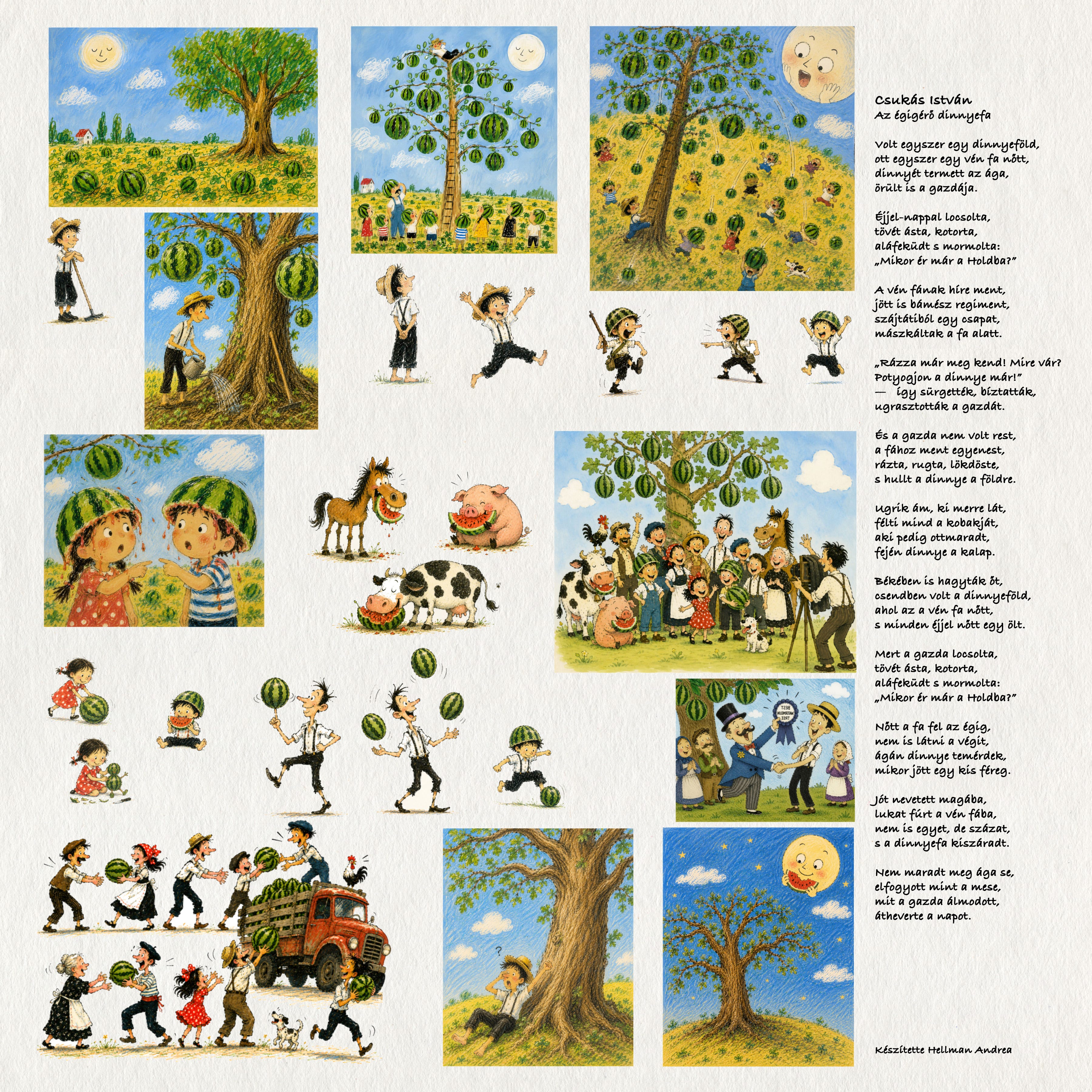
Once there was a melon field.
In that field an old tree grew.
A watermelon tree.
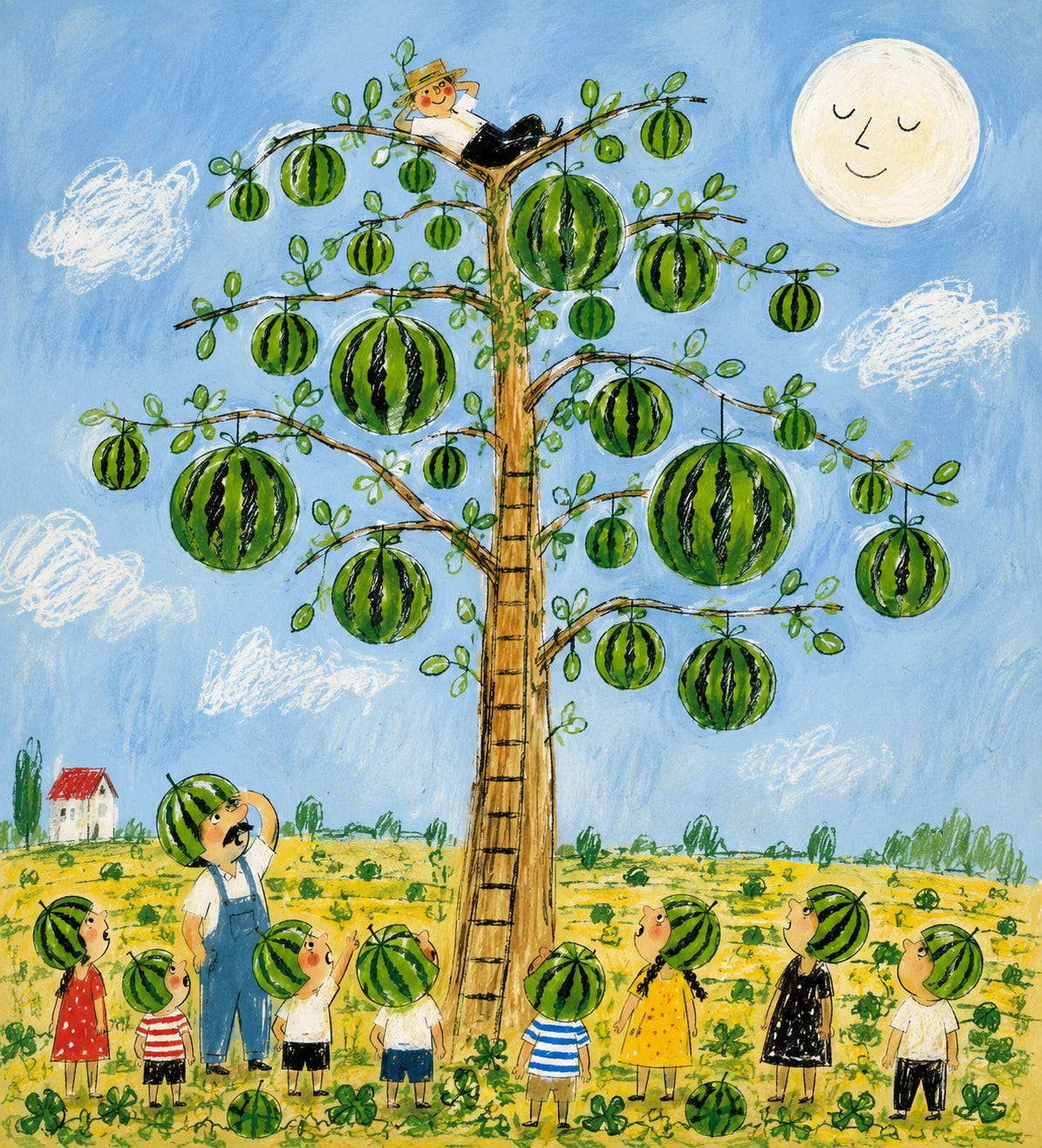
Watermelons hung from every branch,
and the melon farmer couldn’t have been happier.
Day and night he watered it.
He loosened the soil around its roots.
Then he’d stretch out underneath and ask:
“How much farther to the Moon?”
The tree became famous.
People came to see it.
A whole parade of gawkers.
A squadron of stare-and-gapers.
They wandered around beneath the branches
with their mouths hanging open.
“Shake it already!”
“What are you waiting for?”
“Let’s have some melons!”
they shouted at the farmer.
The farmer was not the waiting kind.
He marched straight to the tree.
He shook it.
He kicked it.
He shoved it.
And down came the watermelons.
The quick ones jumped aside.
The cautious ones ducked.
The unlucky ones stayed put.
One fellow went home
wearing a watermelon hat.
After that, everybody left.
The melon field grew quiet again.
Only the farmer remained.
Day and night he watered it.
He loosened the soil around its roots.
Then he’d stretch out underneath and ask:
“How much farther to the Moon?”
The tree grew taller every night.
A little taller.
And a little taller.
Soon it rose above the swallows.
Above the crows.
Above the clouds.
No one could see the top anymore.
Its branches were loaded
with watermelons by the thousand.
Then one day
a tiny worm came by.
The worm took one look
and laughed to himself.
He bored a hole in the trunk.
Then another.
Then another.
Not one hole.
Not ten.
Hundreds.
The old tree began to dry out.
Its leaves curled.
Its branches withered.
And before long,
the great watermelon tree was gone.
Not a branch remained.
Not a single watermelon.
It disappeared like a story
that has reached its last page.
As for the farmer—
he lay in the melon field all afternoon,
looking up at the sky,
still wondering:
“How much farther to the Moon?”
Csukás István
Az égigérő dinnyefa
Volt egyszer egy dinnyeföld,
ott egyszer egy vén fa nőtt,
dinnyét termett az ága,
örült is a gazdája.
Éjjel-nappal locsolta,
tövét ásta, kotorta,
aláfeküdt s mormolta:
„Mikor ér már a Holdba?”
A vén fának híre ment,
jött is bámész regiment,
szájtátiból egy csapat,
mászkáltak a fa alatt.
„Rázza már meg kend! Mire vár?
Potyogjon a dinnye már!”
— így sürgették, bíztatták,
ugrasztották a gazdát.
És a gazda nem volt rest,
a fához ment egyenest,
rázta, rugta, lökdöste,
s hullt a dinnye a földre.
Ugrik ám, ki merre lát,
félti mind a kobakját,
aki pedig ottmaradt,
fején dinnye a kalap.
Békében is hagyták őt,
csendben volt a dinnyeföld,
ahol az a vén fa nőtt,
s minden éjjel nőtt egy ölt.
Mert a gazda locsolta,
tövét ásta, kotorta,
aláfeküdt s mormolta:
„Mikor ér már a Holdba?”
Nőtt a fa fel az égig,
nem is látni a végit,
ágán dinnye temérdek,
mikor jött egy kis féreg.
Jót nevetett magába,
lukat fúrt a vén fába,
nem is egyet, de százat,
s a dinnyefa kiszáradt.
Nem maradt meg ága se,
elfogyott mint a mese,
mit a gazda álmodott,
átheverte a napot.